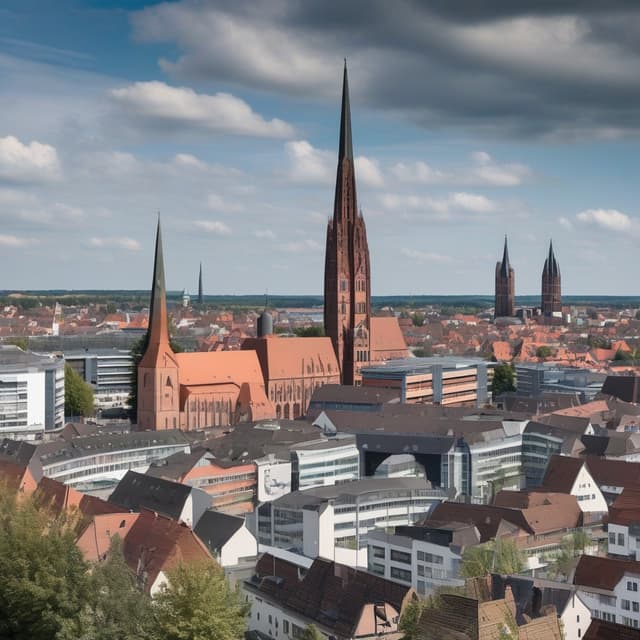
| Name | Hamm |
| State | |
| Country | |
| History | Important industrial and transportation hub, strategic battleground in German Unification Wars (1850s-1870s), survived WWII with little damage, grew as logistics, manufacturing, and technology center in postwar period |
| Population | Over 180,000 |
| Characteristics | Diverse, cosmopolitan city with heavy industry, modern services, and cultural attractions |
Hamm is a major city in the state of North Rhine-Westphalia, Germany, with a population of over 180,000 as of 2020. Located near the confluence of the Lippe River and Ahse River, it has long been an important industrial and transportation hub, playing a pivotal role in the economic development of the region.
The town of Hamm was first mentioned in historical records in 851 CE and grew around a Benedictine monastery. In the 16th century it became an increasingly important trading post due to its location on key inland waterways.
Hamm's industrial revolution began in the early 19th century with the establishment of coal, steel, and chemical factories. The arrival of the railroad in 1849 further cemented its status as a transportation hub, with the city becoming a major node in the regional rail network. By 1870, Hamm was one of the most industrialized cities in the German Confederation.
During the tumultuous German Unification Wars of the 1850s-1870s, Hamm found itself at the center of the conflict as a strategic battleground. Its factories, rail yards, and river crossings were the sites of several major battles between the forces of Prussia and its rivals. The city endured occupation, bombardment, and economic disruption during this period before ultimately becoming part of the newly formed German Empire in 1871.
Despite the upheaval of the Unification Wars, Hamm continued to grow and industrialize in the late 19th and early 20th centuries. New steel mills, chemical plants, and engineering works were established, and the city expanded its rail, road, and river infrastructure to support its economic importance. By 1910, Hamm had a population of over 50,000 and was a thriving urban center.
Hamm escaped the large-scale destruction suffered by many German cities during World War II, with only limited bomb damage to its industrial facilities. As a result, it was able to quickly recover in the postwar period and resume its role as a vital transportation and manufacturing hub.
In the decades since, Hamm has further diversified its economy, developing a strong logistics, services, and high-tech sector alongside its traditional heavy industries. It has also become a more cosmopolitan city, home to growing immigrant communities and a vibrant cultural scene. Major employers today include Deutsche Bahn, Siemens, and a number of Fortune 500 manufacturing and logistics firms.
Today, Hamm is a bustling, diverse city that retains its industrial character while also evolving into a center of commerce, culture, and innovation. Key landmarks include the historic Hamm Cathedral, the modernist Hamm Main Station, the Hammer Waterworks museum, and the futuristic Hamm Innovation Park. The city's ethnic restaurants, art galleries, and lively public spaces reflect its status as a thriving, 21st century urban center.
Despite the economic and social changes it has undergone, Hamm remains an important transportation hub, with major highways, rail lines, and inland ports facilitating the movement of goods, services, and people across Germany and beyond. Its mix of heavy industry, logistics, and high-tech enterprises make it a vital cog in the broader Rhine-Ruhr metropolitan region, one of the most economically powerful areas in Europe.
